
Michela Sborchia
Womb & Heart Alchemist
Understand your Perimenopause Journey
And find Freedom Through Challenges & Changes
Our Natural Cycles
Menopause has three main stages: Perimenopause, Menopause, and Postmenopause. However, some research, like Coslov et al. (2021) and Cortes et al. (2023), suggest an additional phase before Perimenopause, called the Late Reproductive Stage (LRS). This stage, often in the late 30s to early 40s, is marked by irregular cycles and early hormonal changes, with symptoms like sleep disruption, mood swings, and brain fog. This study identified prevalent symptoms during the LRS, including sleep disruption, mood fluctuations, hot flashes, and brain fog, between their late 30s and early 40s.
Between her 40’s and early 50’s, a woman can start experiencing perimenopause symptoms. Many different symptoms fall under the umbrella term of perimenopause, some common, some less common and some curious. The most common symptoms are hot flashes, fatigue, sleep disturbances, vaginal dryness, headache, irregular periods, and anxiety, just to name a few.
Menopause occurs 12 consecutive months (or, if you have a fairly regular period, 13 consecutive missed bleedings) after your last menstrual cycle. So, if we think about it, menopause it’s just one day. Perimenopause is your threshold; Menopause is the step you take through that doorway into Post-Menopause or the rest of your life.
Generally, according to the British Menopause Society, the typical ages for different stages of menopause are as follows:
· Perimenopause - often begins in the 40s, though it can start earlier.
· Menopause- typically occurs between ages 45-55.
· Post-Menopause - this stage follows menopause and lasts for the remainder of life
· There is also induced menopause that happens after a severe illness, medical treatments, and surgery.
· In young adults, before the age of 40, it is defined as premature menopause or premature ovarian insufficiency (POI). According to the British Menopause Society, POI can begin as early as the teens or twenties in rare cases, and symptoms can include irregular periods, hot flashes, and other menopausal symptoms.
Picture from
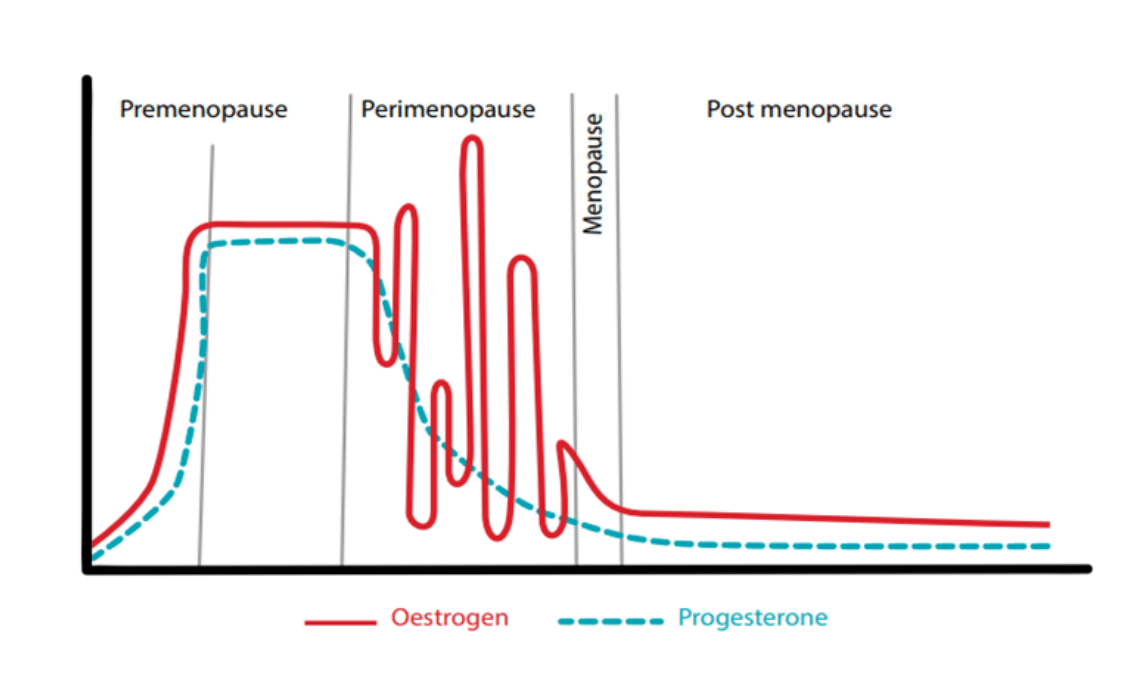
This graphic shows the fluctuations of hormones from pre- to post-menopause. As the store of eggs in the ovaries depletes, the levels of oestrogen and progesterone can become more erratic. Women have hormone receptors all over their bodies, so when hormone levels fluctuate and fall, the body will have to adjust, bringing in all the symptoms we experience physically, psychologically, and cognitively. While progesterone levels continue to fall, oestrogen levels fluctuate until post-menopause.
How and why does menopause happen?
From a biochemistry perspective, menopause happens when women start to experience a decline in hormone levels.
· During the LRS, we can still bleed regularly but have fewer ovulations. Because we ovulate less than usual, the progesterone levels gradually fall. This happens because progesterone is produced mainly in the ovaries by the corpus luteum, which is the substance that develops after ovulation occurs and the follicle around the egg collapses.
· During perimenopause, the ovaries gradually produce less oestrogen and progesterone, leading to hormonal fluctuations. Ovulation becomes irregular, but it’s still possible to get pregnant. At this stage, there is an increase in FSH follicle-stimulating hormones in an attempt to stimulate the ovaries by the anterior pituitary gland (feedback loop mechanism).
· Prioritising gut and liver health during perimenopause is essential because these organs play crucial roles in managing the hormonal changes and metabolic shifts that occur during this stage of life, as they help break down and release hormones from the body.
· Menopause to Post-Menopause is officially diagnosed after 12 consecutive months without a menstrual period. The average age of menopause is around 51. During this phase, the FSH level can still be high initially, but gradually reduces and returns to a more stable level. Perimenopausal symptoms become less intense over time.
Important Note
Menopause symptoms are not a health risk in and of themselves. We are not broken or damaged; we are simply changing. But because of the fall in hormones, this is a good time, if we haven’t done that yet, to check with our healthcare provider and asses our physical, emotional and mental well-being, as these changes can lead to three main areas of concern: Osteoporosis, Cardiovascular diseases, and Cognitive decline.
Symptoms
According to the HSE (Ireland's public health and social care service), the most common symptoms of menopause are:
hot flushes
night sweats
fatigue
lack of energy
low mood or anxiety
problems with memory or concentration
vaginal dryness and pain, itching or discomfort
reduced sex drive (libido)
discomfort during sex
irregular periods
headaches
heart palpitations (a fast-beating, fluttering or pounding heart
recurring UTI
loss of muscle
weight gain
joint aches and pains
Some of the less and curious symptoms are:
· Burning Mouth Syndrome
· Electric Shock Sensations
· Itchy Skin
· Body Odor Changes
· Increased Anxiety and Depression
· Hair Loss
· Tinnitus
· Cold flushes
· Rage
· Formication
· Dry mouth
· Numbness in your limbs
· Dry or itchy eyes
Women’s struggles through change
Although the transition from Perimenopause to Postmenopause is as natural as breathing, it can bring up many challenges. This is not a “one size fits all” kind of journey. There are many symptoms and different ways of experiencing it depending on our environment and personal history. When we talk about the struggles we experienced during this rite of passage, we can never speak for every woman on this earth. It’s crucial to understand that each woman’s experience is unique, and assuming that Menopause is hard or easy (depending on whom we are talking to) will separate us from other women’s experiences and stories. By doing so, we’ll fail to address one of the most critical issues in Menopause (at least for me): that many women are unhappy about moving through this transition (for different reasons) and listening to their stories is not just important; it’s essential. It will help us understand this passage even more and create a sense of engagement, community and connection.
However, the scientific world notes that there are three main areas of concern when it comes to physical and mental health that can happen due to the drop in hormone levels.
Osteoporosis | Oestrogen plays a crucial role in maintaining bone density by helping to regulate bone remodelling and calcium absorption. With the drop in oestrogen during menopause, bone breakdown outpaces bone formation.
Cardiovascular diseases | Oestrogen has protective effects on the cardiovascular system. It helps maintain healthy blood vessel function, regulate cholesterol levels, and reduce inflammation.
Cognitive decline | Oestrogen has neuroprotective properties; it supports neurotransmitter function, blood flow to the brain, and neural health, all contributing to cognitive function.
Something important to keep in mind is that we are just in the early years of research and studies on Menopause, and we can never assume that a woman's symptoms are connected to any of these phases. If a client or a student comes to us with typical symptoms of this passage, we should always refer them to a GP or Healthcare Provider and refrain from diagnosing them. In the case of fibromyalgia, for example, if pain presents itself around the time we should be in the LRS or Perimenopause, we cannot assume that the pain is due to the fluctuation of hormones that happens in Perimenopause.
Menopause is experienced differently worldwide, shaped by personal, family, and sociocultural factors. Cross-cultural studies reveal geographical and ethnic variations. Some research and findings suggest that menopause experiences vary widely and are influenced by cultural context, challenging the idea that menopause is equal for all.
When I asked the women in my life about their struggles during this rite of passage, I wasn’t surprised to hear many different answers. As I mentioned earlier, menopause is not a one-size-fits-all kind of passage. It varies from woman to woman, which is why this journey is deeply fascinating.
These are some of the most common struggles of daily life for a woman during perimenopause:
On a physical level, beyond the most common symptoms of hot flashes, night sweats, sleep disturbances, and weight gain, which can still disrupt daily life and lead to fatigue, some women also struggle with physical pain. Some women develop severe issues like pelvic floor dysfunctions. All of this can be physically, mentally and emotionally painful, leading us towards more profound emotional changes like anxiety, depression, feeling unworthy, useless and invisible. Mood swings, anxiety, rage and depression can occur due to hormonal fluctuations, but also because moving through all these changes can honestly try the patience of a saint. And even though we live in a modern society, sometimes women see that supportive healthcare providers and effective treatments can be challenging, especially if symptoms are not taken seriously.
Many women also experience a sense of loss or anxiety about ageing. Grief is one of the most profound experiences we allow to surface during perimenopause, and Grief is such an important piece of the puzzle on our healing journey.
Decreased libido, vaginal dryness, and discomfort during intercourse can affect sexual relationships. Pleasure and Joy can be difficult to reach in everyday life as the feel-good hormones like oxytocin are at a new low because oestrogen is known to influence the production and regulation of oxytocin, which is often associated with bonding, emotional responses and reproductive functions.
Some studies suggest that changes in oxytocin can also influence mood and may contribute to feelings of anxiety or depression that some women experience during menopause. However, the exact relationship can vary among individuals, and more research is needed to understand these dynamics fully.
Evolution
From an evolutionary perspective, we don’t currently know why menopause happens. Several theories have not been proven to be right or wrong. They attempt to explain menopause as follows:
The "Grandmother Hypothesis": This theory suggests menopause evolved to allow older women to shift their focus from childbearing to helping raise their grandchildren.
The "Mother Hypothesis": According to this theory, menopause protects women by stopping childbirth at an age when the risks of complications for both mother and child increase significantly.
The "Reproductive Conflict Hypothesis": This theory posits that menopause arose to reduce reproductive competition between older women and their daughters-in-law.
The "Embodied Capital Theory": This theory suggests that menopause is a life-history strategy focusing on reallocating resources.
The "Patriarch Hypothesis": This hypothesis is primarily centred on men’s evolutionary patterns but indirectly impacts female reproductive strategy.
And last but not least...
Although there seems to be more awareness of menopause nowadays, I feel we need to be more cautious with what is passed off as standard information.
I know this is a difficult time for women, but the gloomy pictures we are given on social media are just a tiny part of the equation.
Menopause can be a tough threshold to cross, but it can also have some surprisingly positive aspects!
Many women experience a newfound sense of freedom and self-acceptance after menopause.
Hormonal fluctuations that once fuelled emotional ups and downs stabilise, often bringing a sense of peace and clarity.
There’s also freedom from menstrual cycles, which can relieve the physical discomfort and planning required each month.
The focus can shift to personal growth, creativity, and exploring interests or goals that may have been put on hold.
It’s a chance to redefine life on our own terms, with the wisdom gained from experience guiding us forward.
Let us know what you think in the comments!


Categories
Thrive-Letter
Subscribe to the newsletter and stay in the loop! You'll receive a free workshop on gratitude straight to your inbox. By joining, you acknowledge that you'll receive our newsletter and can opt-out anytime hassle-free.
Created with systeme.io © 2025 Michela Sborchia, All Rights Reserved